Vercel Launches Drives Public Beta to Provide Persistent Storage for Vercel Sandboxes
Vercel has introduced Drives in public beta, bringing up to 16 TiB of persistent, pay-as-you-go storage to Vercel Sandbox environments across all tiers. This allows developers to persist state, share files between sandbox instances, and optimize workloads like AI agent caching.
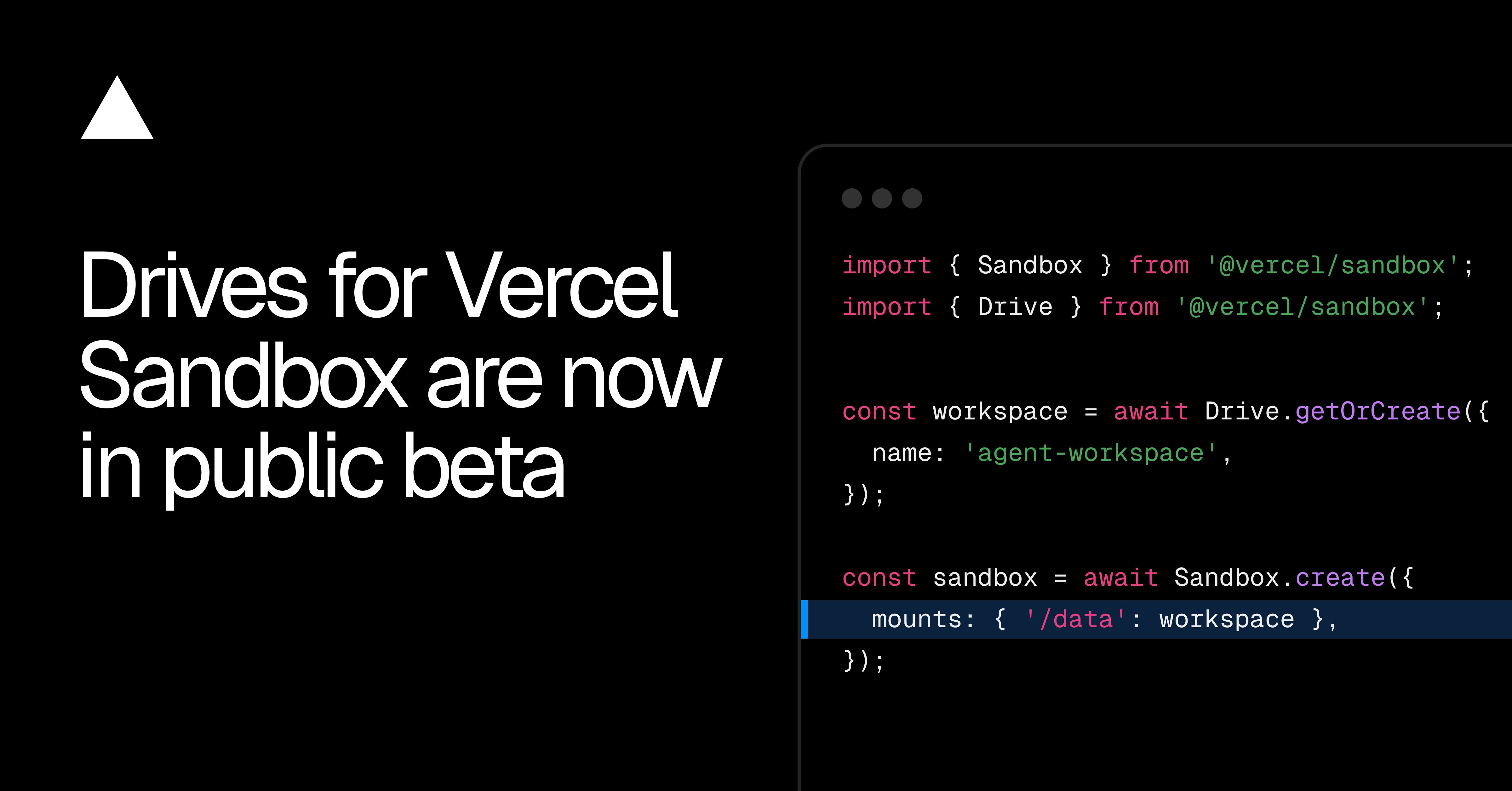
Vercel has released the public beta of Drives, a persistent storage solution integrated directly with Vercel Sandbox environments. Available to users on Hobby, Pro, and Enterprise plans, Drives can be mounted to any directory inside a sandbox. Because these storage drives maintain a lifecycle independent of individual sandbox runs, they facilitate seamless state preservation and data sharing across multiple active instances. Previously, Vercel Sandbox environments operated on an ephemeral model where all data was destroyed upon execution completion. The introduction of Drives allows development teams to persist complex runtime assets, such as AI agent workspaces, localized memory structures, large datasets, and pre-trained machine learning models. Offering storage capacities up to 16 TiB, this feature also enables the caching of dependency trees to dramatically reduce sandbox startup and build times. Interactions with mounted drives utilize standard file system operations, allowing teams to adopt persistent storage without refactoring their existing codebases. Usage is billed on a pay-as-you-go consumption model, with drives configured and attached at sandbox initialization. As this feature is currently in public beta, developers should expect potential adjustments to specifications, pricing structures, and usage quotas ahead of the general availability release.
Primary source
Open Vercel Changelog ↗This article summarizes the source. Check the original for full details and conditions.
Comparison
| Aspect | Before / Alternative | After / This |
|---|---|---|
| Data Lifecycle | Ephemeral (destroyed immediately after sandbox execution completes) | Persistent (retained independently of sandbox lifecycles) |
| Inter-instance Sharing | No native way to share local state between separate sandboxes | Shared access to the same drive across multiple instances |
| Maximum Capacity | Restricted to standard ephemeral container disk allocations | Scalable persistent storage volumes up to 16 TiB |
| Primary Workloads | Stateless code execution and short-lived build testing | AI agent state retention, machine learning model caching, and persistent dependency trees |