Streamlining Robotics Workflows with Strands Agents, LeRobot, and Hugging Face Storage
Hugging Face has introduced an integrated pipeline combining Strands Agents, LeRobot, and Hugging Face Storage Buckets to simplify recording, training, and deploying robotics data. This integration ensures robust data streaming and seamless version control for AI-driven physical agents.
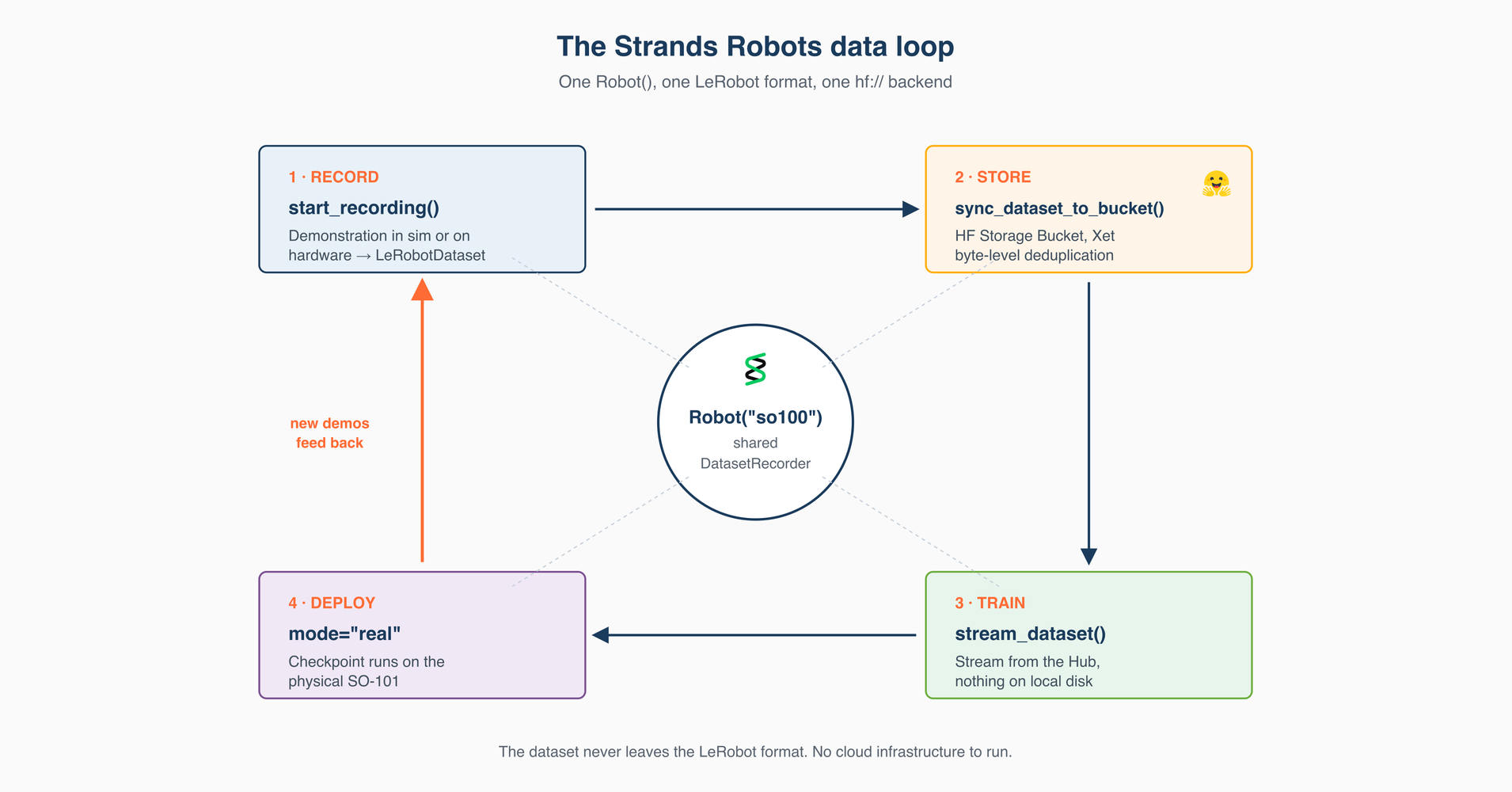
The integration of Strands Agents with LeRobot and Hugging Face Storage Buckets creates a unified loop for managing robotics data. Previously, developers had to rely on fragmented tools to record physical demonstrations, upload them to remote storage, train policies, and deploy them back to hardware. This update establishes a cohesive workflow that minimizes manual intervention and streamlines data pipeline setup.
Primary source
Open Hugging Face Blog ↗This article summarizes the source. Check the original for full details and conditions.
Comparison
| Aspect | Before / Alternative | After / This |
|---|---|---|
| Data ingestion | Manual export, conversion, and multi-step custom script uploads | Direct streaming to Hugging Face Storage Buckets in real time |
| Training pipeline | Decoupled model training requiring manual local dataset synchronization | Tight integration with LeRobot for immediate training from cloud buckets |
| Deployment feedback | Disjointed evaluation cycles with high latency between policy updates | Continuous recording, evaluation, and redeployment via Strands Agents |
Action Checklist
- Configure Hugging Face Storage Buckets in your workspace environment Ensure proper write permissions are set for streaming real-time data.
- Install and initialize the Strands Agent on your local robotics hardware Verify connection stability before running data collection sessions.
- Configure the LeRobot library to pull datasets directly from the remote bucket This reduces local storage requirements and speeds up multi-node training.
- Execute a test run to record, train, and deploy a simple robot manipulation policy Check logs to confirm compatibility across input and output formats.


